
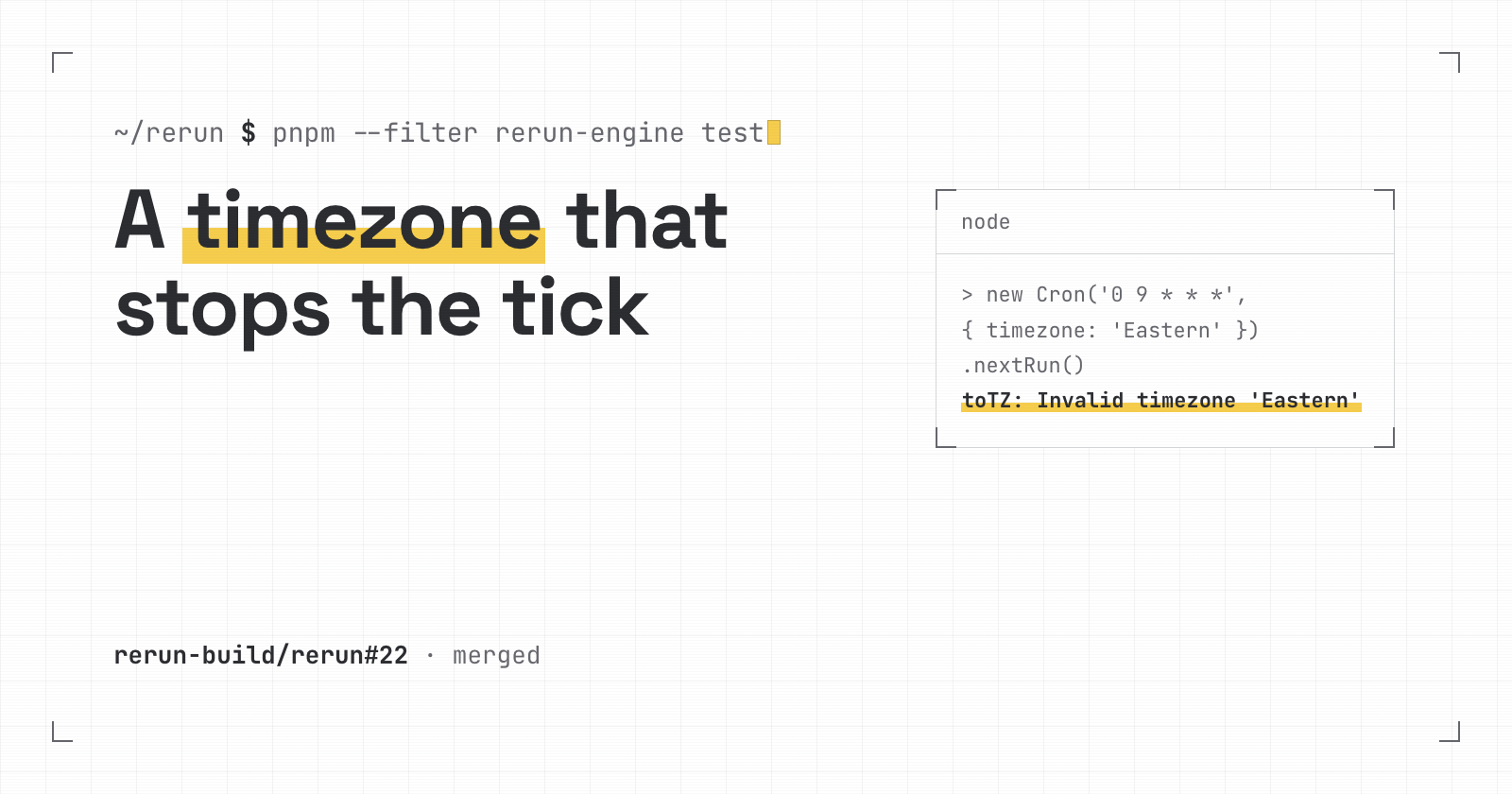
Say you set up a job to run every morning at 9 in your timezone, and you type the timezone as Eastern. The app saves it without a word. Later, quietly, the part of the app that runs all the scheduled jobs trips over that one word.
That was possible in Rerun, a self hostable app where you set up digital coworkers that use your tools and work on a schedule. I found it by reading the source, wrote it up as issue #21, and fixed it in rerun-build/rerun#22.
Routines, cron and timezones
In Rerun, a coworker can have routines: saved jobs that repeat. Each one has a cron expression, a short code for a repeating time such as 0 9 * * * for "every day at 9:00", and optionally a timezone.
Timezones have official names from a shared list called the IANA database, like Europe/Paris or America/New_York. A few short aliases work too, such as UTC, EST or US/Eastern. But Eastern, Pacific Time or a typo like Europe/Pariss aren't on that list.
A scheduler inside Rerun's engine wakes up every 30 seconds. Each time, called a tick, it looks at every routine of every active coworker and asks "is this one due yet?". If it is, it runs it.
Where the bad value slipped through
Routines can be created in two ways: by the coworker itself, through tools called schedule_create and schedule_update, or through the app's web routes. Both checked the cron expression and the one off run time. Neither checked the timezone. Any text was accepted.
The second part is the library. Rerun uses croner, a JavaScript cron library, to work out the next run time. croner will build a schedule with any timezone text you give it, no questions asked. It only fails when you actually ask for a run:
> new Cron('0 9 * * *', { timezone: 'Eastern' }).nextRun()
TypeError: CronDate: Failed to convert date to timezone 'Eastern'. ...
I trimmed the end of that message, which goes on to suggest using an IANA name. So a bad timezone sailed through when it was saved and only blew up later, when someone needed the answer.
What happened after that
Picture a teacher taking the register. She reads each name in order and ticks it off. If one name on the list is smudged and she can't read it, she stops right there, and everyone after it never gets marked present.
The scheduler's tick worked the same way. It asked croner about each routine in a plain loop with no try around it. When it hit the bad timezone, croner threw an error and the loop stopped. Every routine after that one, for that coworker and for every coworker after it, went unchecked on that tick.
It could get worse. The tick was started as void tick(), which means "run this, and don't wait for the result". So the error had nowhere to go. In Node, an async error nobody handles (an unhandled rejection) ends the whole process by default, and the engine had no handler of its own. I didn't run a full self hosted setup, so I want to be clear: the process exit follows from reading the code, not from a crash I watched. The croner error itself I did check, with the same croner version the repo uses, 10.0.1.
The coworker's own tools were hit too. schedule_list and schedule_get ask for each routine's next run, so they failed the same way. A cron expression that doesn't parse, say one typed into a routine file by hand, took the same path.
The fix, part one: one bad routine can't stop the rest
First, the engine stopped assuming croner never throws. The two places that asked for a next run now go through one small helper:
function nextCronRun(schedule: Schedule, from: Date): Date | null {
    try {
        return cronFor(schedule).nextRun(from)
    } catch {
        return null
    }
}
If croner can't work out a run, the answer is null, meaning "no next run". A routine with no next run is never due, so the tick skips it and moves on to the next one. schedule_list shows "never" for it instead of failing. Rerun's web interface already handled it exactly this way: its own version of nextRunAt wraps croner in try and catch. Now the engine matches.
The fix, part two: refuse it when it's saved
Second, a bad timezone gets turned away up front. I could have kept a list of valid timezone names, but lists drift out of date. Instead, the check asks croner itself:
export function isValidTimezone(timezone: string): boolean {
    try {
        new Cron('* * * * *', { timezone }).nextRun()
        return true
    } catch {
        return false
    }
}
It builds a throwaway schedule that runs every minute, asks for one run, and reports whether that worked. So it accepts exactly the timezones the scheduler will later be able to use, nothing more and nothing less.
The check sits right next to the existing cron and run time checks. The coworker tools now answer Invalid timezone: Eastern. Use an IANA name, e.g. 'Europe/Paris' or 'America/New_York'. and save nothing. Creating a routine through the web route gives a 400 error, the web's "bad request" answer, with body: Invalid timezone, and editing one gives a 400 with invalid timezone. Leaving the timezone empty still means "no timezone".
Tests
Every new test fails on the main branch without the fix. The cron tests check which names isValidTimezone accepts and rejects, and that a routine with an unknown timezone or a broken cron is simply not due and has no next run, instead of throwing. The tool tests check that a refused create saves nothing and a refused update keeps the old timezone. The route tests check the two 400 answers.
There were no review comments. ClementJanssens merged it on 6 November 2026, then wrote a short summary on the issue of what the fix does and thanked me for the report and the fix. Thanks, ClementJanssens!
What I'm keeping from this one
If a library checks its input late, check early using the library itself. Asking croner "can you run this?" stays correct as croner changes, and a hand written list wouldn't.
A loop that works through everyone's jobs shouldn't let one bad job stop the rest. Skip it, and keep going.
And when you report something you found by reading code, say so. Writing that the process exit follows from the code was honest. Writing "it crashed" would not have been.
Have you ever had a timezone name that looked fine and wasn't? I'd like to hear which one.
About the author
- I contribute to open source developer tools: Tauri, Biome, oxc, Julia, Quarkus, Grafana, Burn and a few more. I start from an issue I can reproduce and a test that fails, then fix it. Here I write up the ones worth telling: what broke, why, and how the fix got through review.
Comments
Join the discussionNo comments yet. Be the first to comment.