
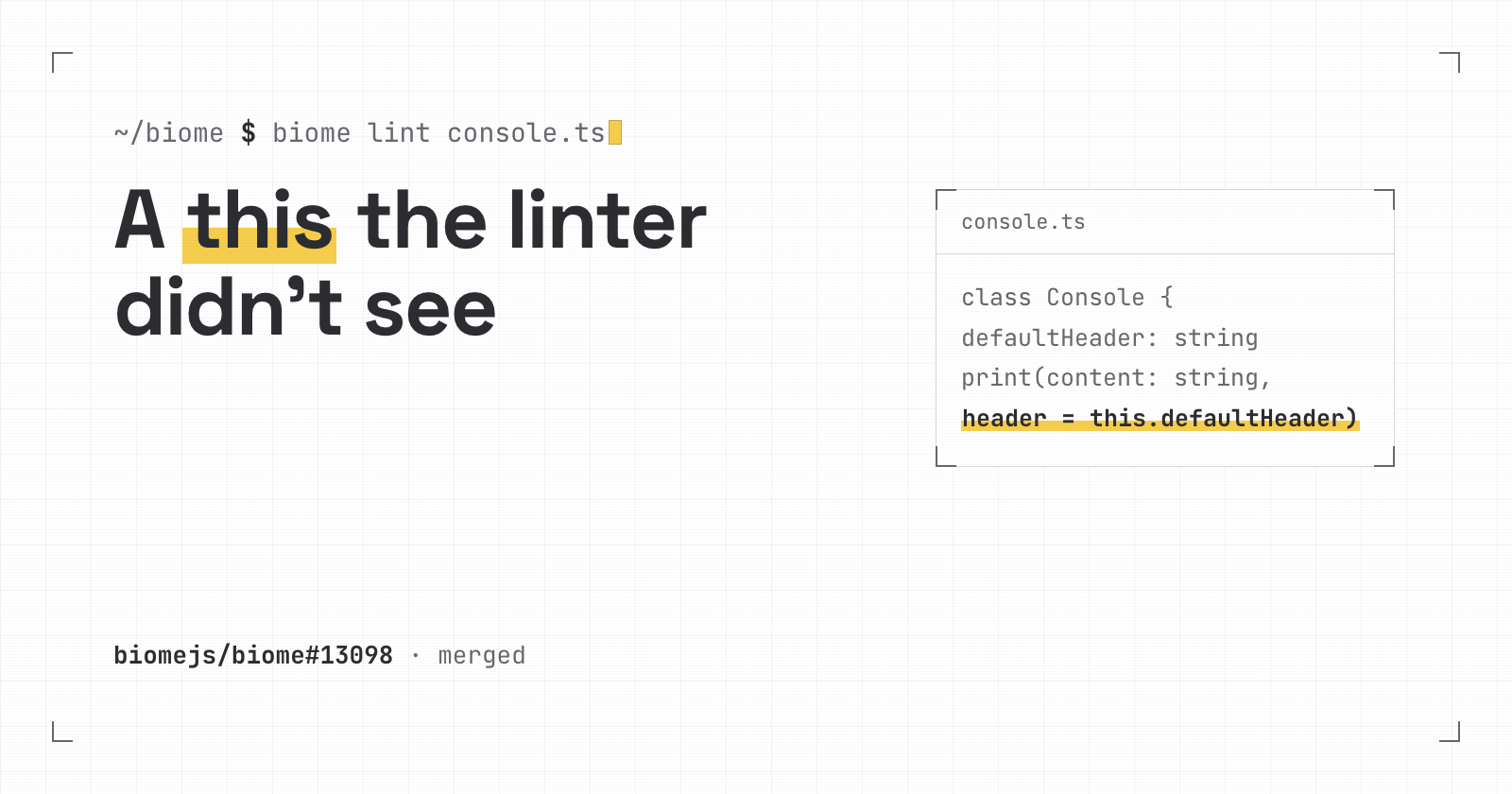
You write a class method, run the linter, and it tells you the method never uses this, so it could be static. You look, and there it is: this.defaultHeader, right in the method's first line. The linter just didn't look there.
That's what luisfi-dev reported in issue #13084 for Biome, a tool that formats and checks web code. I picked it up, and the fix was merged in biomejs/biome#13098.
The rule and what it's for
A linter is a program that reads your code without running it and points out likely mistakes or style problems. Each check is called a rule. Biome's useThisInClassMethods rule, which mirrors ESLint's class-methods-use-this, looks for class methods that never use this.
In JavaScript, this inside a method means "the object this method was called on", much like self in Python. A method that never touches this doesn't need an object at all. It could be static, meaning it belongs to the class itself rather than to each object, or it could move out of the class. That's a fair hint, as long as the rule is right about this.
Here is the code from the issue, trimmed from their playground:
class Console {
  defaultHeader: string

  print(content: string, header = this.defaultHeader) {
    console.log(`=== ${header.toUpperCase()} ===`);
    // trimmed
  }
}
The header = this.defaultHeader part is a default parameter value: if you call print("hi") without a header, JavaScript fills in this.defaultHeader. The method body itself never says this. But the default does, and as a comment in their playground pointed out, making this method static would make that this stop working.
Why the rule missed it
Think of a method as a recipe card. At the top there's the ingredient list, which is the parameters. Below it are the steps, which is the body. The rule only read the steps. If the ingredient list said "a cup of whatever's in your own fridge", it never noticed you needed your own fridge.
The default value runs whenever the method is called without that argument, and it runs with the same this as the body. So it counts. But the rule only searched one place:
Self::JsMethodClassMember(member) => {
    Some(uses_lexical_this(member.body().ok()?.syntax()))
}
Biome is written in Rust. This line says: for a method, look for this inside its body, and nowhere else. Setters, the methods that run when you assign to a property, worked the same way. A this in the parameter list was never seen.
The fix
Methods and setters now look at their parameters as well as their body:
// A parameter's default value runs with the method's `this`.
Self::JsMethodClassMember(member) => Some(
    uses_lexical_this(member.parameters().ok()?.syntax())
        || uses_lexical_this(member.body().ok()?.syntax()),
),
|| means "or": if either the parameters or the body use this, the method uses this.
The rule also checks class fields whose value is a function, like arrowField = (value = 1) => value. Those got the same change, so arrowField = (value = this.defaultHeader) => value now counts as using this too.
I passed the parameters and the body separately on purpose, rather than the whole method. That way the rules the body already followed apply to defaults too. JavaScript has two kinds of function. An arrow function (() => ...) borrows this from around it. A regular function gets its own this. So read(callback = () => this.defaultHeader) uses the method's this and is fine, while read(callback = function () { return this.value; }) doesn't, and is still reported.
TypeScript adds one more trap. You can write method(this: ThisParameterOnly, value = 1), where this: only declares what type this has. It isn't a use, so that method is still reported. The test files cover each of these.
What review changed
Biome runs CodeRabbit, a review bot, on its PRs. One of its notes, marked minor, found a real hole in my change.
Parameters can have decorators. A decorator is the @something(...) you can put in front of a parameter in TypeScript, to attach extra behaviour. Going back to the recipe card, it's like a sticker the printer put on the card when the cookbook was made. It's on the card, but it was applied long before anyone cooked.
That's how decorators work too: their code runs once, when the class is created, not when the method is called. So for a class built inside another function, method(@decorate(this.key) value: unknown) { return value; } would now be treated as using this, even though the method never uses its own this. My parameter check walked the whole parameter list, decorators included.
The fix was to treat a decorator like the places the rule already skipped, such as a class nested inside the method:
if AnyJsClass::can_cast(node.kind())
    || JsStaticInitializationBlockClassMember::can_cast(node.kind())
    // A parameter decorator runs when the class is defined, not with the member's `this`.
    || JsDecorator::can_cast(node.kind())
    // trimmed: the existing check for nested non arrow functions
When the search reaches a decorator, it no longer looks inside. Two more test files cover it. One has methods whose only this is inside a decorator, and they're reported. The other has a decorator plus a real default, method(@decorate(this.key) value = this.fallback), and that one is fine.
Run on the main branch without the fix, the two "valid" test files fail. Without just the decorator part, the decorator "invalid" file fails. With the whole PR, all 18 cases pass.
Right after the bot's review, dyc3 asked me to follow the PR template, which I hadn't filled in. Fair point, so I did. dyc3 approved and merged it on 11 November 2026, the same day I opened it. Thanks, dyc3!
What I'm keeping from this one
Whether a method uses this depends on when each piece of code runs. Where it's written can fool you: defaults run with the call, and decorators run with the class.
When you widen what a check looks at, ask what else you just pulled in. Going from the body to the parameters pulled in decorators.
And fill in the template before anyone reads your PR. It's there so reviewers don't have to ask.
Have you hit a lint rule that was right about the body and wrong about the signature? I'd like to hear about it.
About the author
- I contribute to open source developer tools: Tauri, Biome, oxc, Julia, Quarkus, Grafana, Burn and a few more. I start from an issue I can reproduce and a test that fails, then fix it. Here I write up the ones worth telling: what broke, why, and how the fix got through review.
Comments
Join the discussionNo comments yet. Be the first to comment.